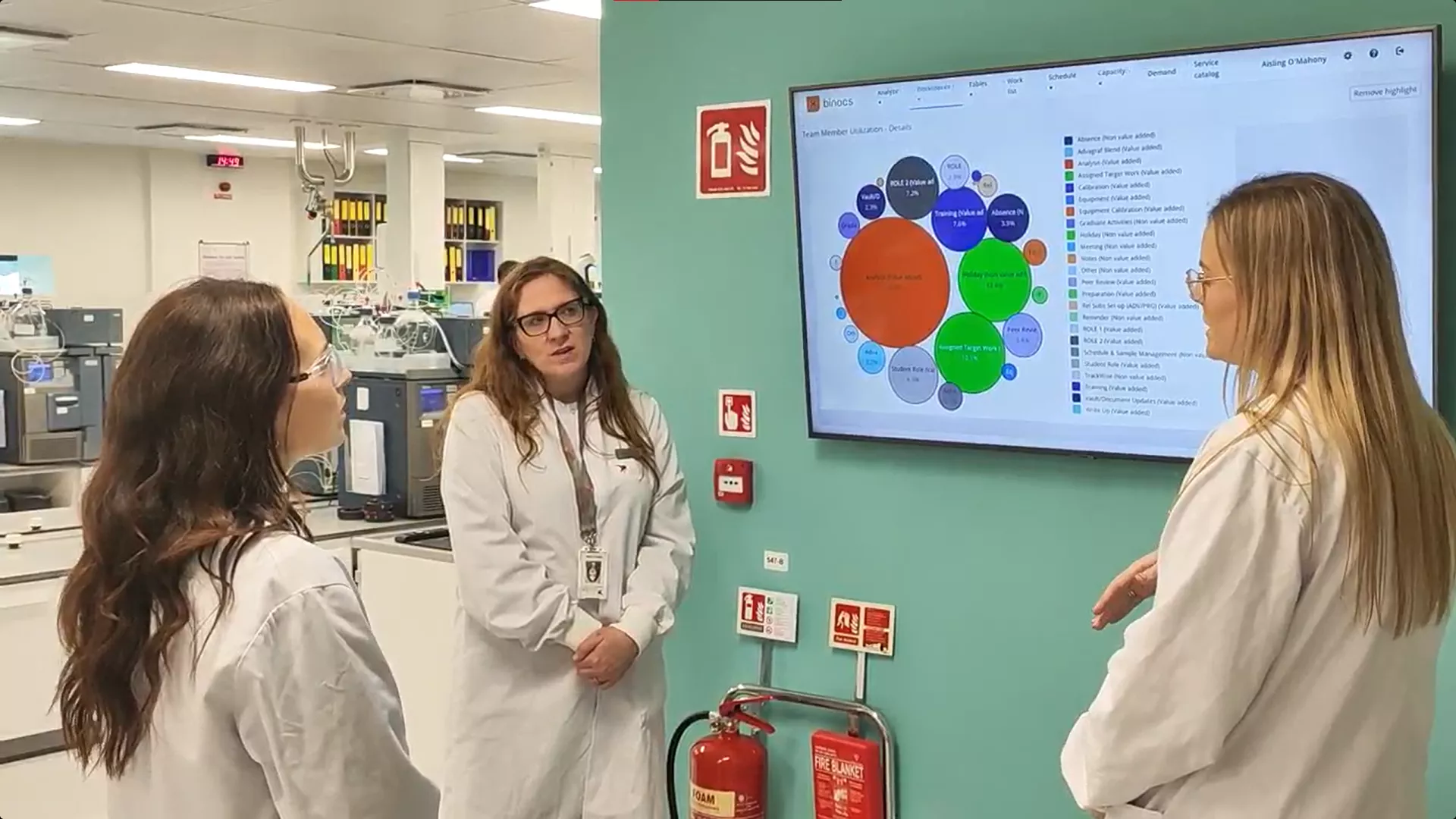
Check out our extended testimonial video and hear what the Astellas Killorglin team themselves have to say about their experience with Binocs.
Alternatively, continue scrolling to read a summary!
Established in 1992, Astellas’ Killorglin site in County Kerry has grown significantly over the intervening 3 decades and, today, produces nearly a billion capsules annually.
Despite this growth, prior to implementing Binocs, the lab relied on outdated manual scheduling methods to manage the daily activities of its 40+ QC chemists, based in pen-and-paper processes supported by complex spreadsheets. Jeremiah Hayes, Director of Quality at Astellas, reflects:
I came into a situation [in 2012] where we were using an A3 sheet of paper to have a list of names, and they tell you the day before what you’re doing.
This approach was not only inefficient but also posed significant risks in terms of knowledge transfer and operational consistency.
Faced with these challenges, Jeremiah and his team began exploring digital solutions. When developing their User Requirements Specification, they identified four minimum criteria for an effective digital system:
-
- Scheduling capabilities
- Comprehensive KPIs
- Training support
- Interoperability
Upon reviewing the various options, the Astellas team selected Binocs based on the fact that it was the only solution to deliver on all four requirements, making it the superior choice. This decision was cemented by Bluecrux’s commitment to delivering effective digital transformation in lab operations.
The implementation process of Binocs at Astellas began with a proof of concept phase. This phase was crucial to demonstrate the system’s capabilities and fit with Astellas’ operational needs. Jeremiah and his team worked closely with Bluecrux to ensure the system could be configured to their specific requirements. As a QC Chemist, Michelle Buckley was actively involved in collecting and collating the lab data for the implementation:
“About a year after I started, we introduced Binocs and it took three and a half to four months to implement, which was very quick and very easy.”
One key to the success of this phase was the appointment of a dedicated champion internally within the QC lab who played a pivotal role in advocating for the system and driving its adoption among the staff.
Bluecrux’s involvement was instrumental in the successful rollout of Binocs. As Jeremiah notes:
“From the very first call to the first time Frederik [VP for Sales, Binocs] came over here, there was an understanding of what Astellas required. These weren’t people who write code and are trying to apply it to something; these are people who saw challenges and came from that environment.”
The Binocs team also provided extensive training and support during the hyper-care period and helped tailor the system to Astellas’ unique needs. This hands-on approach ensured that the implementation process was smooth and that the system was effectively integrated into daily operations.
The Astellas team implemented several internal policies to support the transition to Binocs. These included:
• Selecting a dedicated internal champion to lead the change;
• Providing time and resources for key team members to become “super users” of the new system;
• Setting-up “clinic” hours for team members to meet with the super users and ask questions or seek clarification;
• Ensuring continuous communication and feedback loops between the QC lab staff and the Binocs team.
These measures helped mitigate the typical resistance to change in a regulated environment and facilitated a smoother transition.
The Astellas Killorglin team also reported enthusiasm for adopting a new system not mired in red tape and complicated regulatory procedures. To quote Jeremiah again:
[By design] the Binocs system isn’t classified as a GMP system, so there was an ability to bring it in and do what we wanted with it. That refreshed the group a bit because there was an ability to work on something that was new and different.