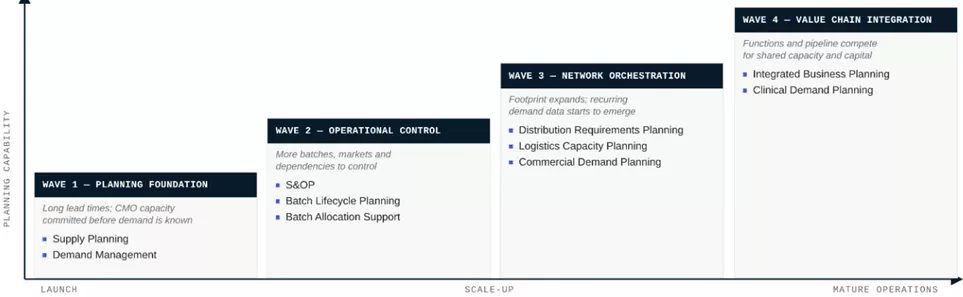
Wave 1: Planning foundation: What should we plan?
Triggered when CMO capacity, the manufacturing plan and inventory have to be committed before demand is known.
Supply Planning earns its place from launch. It protects growth before the network becomes a constraint, and needs DS, DP and FDP modelled as one connected flow, with accurate capacity, yields, batch sizes, lead times and shelf life. Planners should be able to compare scenarios quickly and see the service, inventory, cost and risk impact of each.
Demand Management starts at the same time, while history is thin and statistical models add little. Demand is built from assumptions about diagnosis, access, adoption, launch timing, persistence and roll-out, and the aim is to make that uncertainty explicit. That needs shared ownership across Commercial, Finance and Supply Chain, versioned forecasts with quantified assumptions, scenarios kept apart from the baseline, and a translation from patients to volumes and SKUs that Supply Planning can use.
Wave 2: Operational control: Can we reliably control what happens between the plan and available product?
Triggered when batches, markets and cross-functional dependencies multiply, usually before full CMO integration is in place.
S&OP earns its place once there are real trade-offs to settle, such as constrained capacity against upside demand, launch inventory against expiry exposure, or which markets get priority when supply is short. It works when the meeting is organized around decisions and scenarios, with explicit assumptions, quantified impact, clear owners and a direct link to the supply plan. Without real trade-offs on the table, it tends to drift into a reporting meeting.
Batch Lifecycle Planning closes a familiar gap. The plan says a batch is coming and CMO emails and systems each hold part of its status, yet nobody has the full picture. Making release timing predictable is worth doing well before full partner connectivity. It depends on a milestone template from production through release that separates forecast, committed and actual dates, shows who owns each step and flags exceptions, while leaving each CMO room to work in its own way.
Batch Allocation Support becomes relevant as products reach more markets and the gap between total and usable inventory grows. It needs accurate batch status and expiry data, market registration and labelling rules, and agreed priorities per market. It proposes allocations, and formal release stays with Quality.
Wave 3: Network orchestration: How to serve markets efficiently?
Triggered when the footprint expands, cold-chain capacity becomes material and recurring demand data builds up.
Distribution Requirements Planning earns its place when central stock and planner judgement can no longer protect every market. It only works once release dates are reliable, allocation is in place and market-level demand accounts for shelf life.
Logistics Capacity Planning follows once the distribution plan gives a forward-looking signal, so lane and cold-chain capacity can be secured ahead of launches, peaks and network changes. It needs a stable distribution plan and visibility of capacity across the network.
Commercial Demand Planning becomes worthwhile when timely data feeds and a repeatable workflow can automate forecast updates and free forecasters up for interpretation. It pays back if there is enough stable data, the approach is segmented and explainable with human judgement still involved, and it measurably beats the current method.
Wave 4: Value chain integration
Triggered when functions and the pipeline compete for the same capacity and capital.
Integrated Business Planning earns its place when decisions have to be reconciled across operational, financial and strategic horizons. It builds on a working S&OP process and needs one shared set of assumptions, with operational scenarios translated into financial and portfolio impact.
Clinical Demand Planning matters once clinical and commercial needs compete for the same DS, DP or packaging capacity. Protocol, enrolment and site activation then have to be treated as demand drivers and planned against the same capacity as commercial demand.
Therapeutic area, manufacturing set-up and M&A strategy can all change these priorities, so treat the map as a guide to adapt to your own situation.
Using this for your own roadmap
Test your foundation. In the first article I asked how quickly you could respond if a key approval came six months early. The more specific question here is whether you could tell within a day if your booked DS and DP slots, batch sizes and remaining shelf life would cover the extra demand. If that means rebuilding spreadsheets, start with the supply planning foundation.
Look at your S&OP. If Commercial, Finance and Supply Chain all join the S&OP call and it still feels like a reporting meeting, real trade-offs probably aren’t common yet, and your priority is likely still operational control.
Name the trigger for your next capability. Capacity and upside demand clashing every planning cycle points to S&OP, and batch status for several products being tracked through CMO emails points to Batch Lifecycle Planning. If you can’t point to a trigger like this, it’s probably not relevant yet.
Early on, the forecast is a set of assumptions and the supply plan is where those assumptions turn into commitments. Build from there, and add each capability once the complexity it deals with shows up in your own business.
In the next article, I’ll look at how companies connect planning and execution across commercial, supply, quality and regulatory, and how it all integrates with their production, transport and distribution partners.
How have planning priorities shifted in your organization as it scaled?
 News
 News